The High-Level Process for Creating a Topical Map with Germans Frolovs
James Dooley: The high-level process of creating a topical map. Today I'm joined with Germans Frolovs, and the amount of people out there now that seem to be, "I'm creating a topical map," and it's just a list of keywords and, if I'm being honest with you, a pile of [bleep]. Then I want to kind of get someone like yourself who's very advanced. You're in private communities, um, with people like Koray and Pavel and Lewis, and a lot of other high-level semantic SEOs. So let's go a bit deeper. What is a high-level process of creating a topical map, in your opinion?
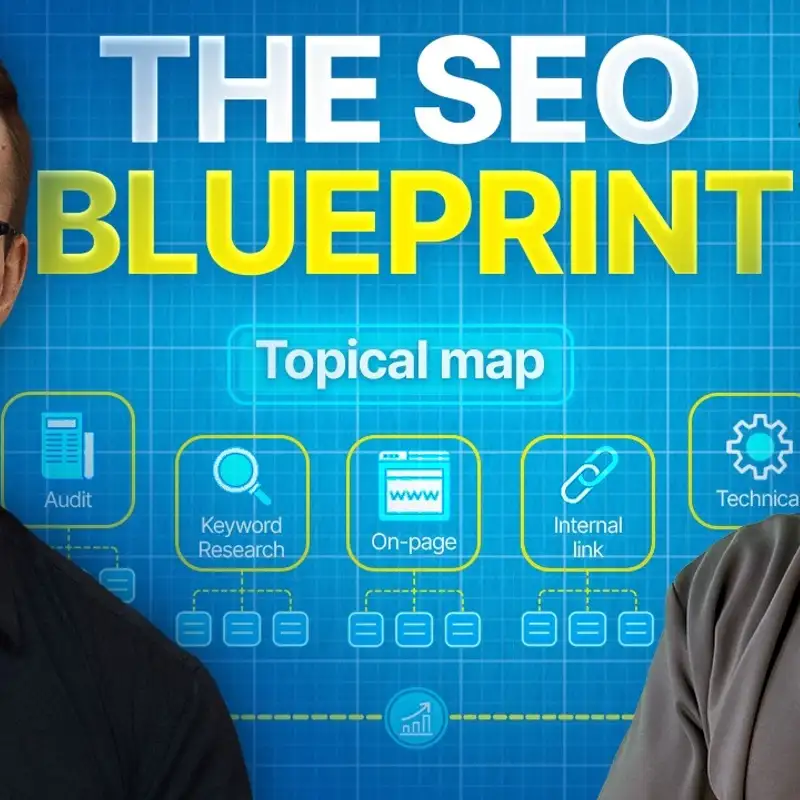
Germans Frolovs: Yes, I think it, uh, on a high level, it starts with defining the four... Like, the five fundamental components or components of the topical map. That would be, uh, identifying what and defining your source context. Uh, what is the purpose of the business? How it earns money? After that, finding out what is the central entity, uh, for, uh, your website. Uh, basically, uh, yeah, the broadest, most, uh, defined entity within that, let's say, topic, that space. And, uh, then also the identification of the central search intent. After that, you define the core and outer sections. And I think that is one of the more, uh, later important, uh, aspects, uh, kind of, like, most important components to figure out so that you don't go too wide or too narrow or, uh, maybe, uh, in places where you shouldn't go. Once that is defined conceptually, then it's so much easier to create the topical map, essentially. Then you just expand in all those categories. Uh, and then, uh, what happens actually after that is, of course... Well, foremost, even before defining the five components, you would need to understand the business model, the product, the audience, uh, the monetisation, uh, effect or the model of monetisation. And also, what are the most important, actually, verbs or, uh, predicates that people use when searching for your service or solution that you're offering? After that, uh, you go into research mode. So once you have defined those five components, it's quite easy to then, uh, find out, okay, in the core section, since I already defined that component, I need to expand on these kind of, like, main attributes. Let's say if you're a SaaS, then have your SaaS plus, uh, of course, the software or the concept where you are operating. Your SaaS or the category plus the software, and just process all the possible software variations. Um, and then, uh, yeah, perhaps there could be also some versus, uh, pages with competitors or alternative pages as part of your core section if you're a SaaS business. And then in the, uh, outer section, essentially talking the whole about industry. Let's say if you're in the project management space, of course, talking about what is project management, talking about the different ways of doing project management, the concepts of project management, uh, all the tools, uh, that are there, from Kanban to Gantt and whatnot. Uh, so once that is defined, you can, with the use of LLMs or with your own mind, start expanding and basically, uh, maybe using some lexical relations, uh, start expanding into hypernyms and hyponyms. Uh, finding what is the hypernym and then just expanding and finding those hypernyms there. That is an easy way. Uh, also, I would suggest going into competitor, uh, sitemaps, identifying what they are writing about, what they are actually also getting traffic for, and also using that as part of your, uh, research and data-gathering process. If you have access to Google Search Console, using all of this data, seeing what is relevant, what is prominent, what has demand, what's popular, and then also covering those, including that in your topical map. And any other keyword research tool if, let's say, your website is not live yet or something to get the data. And then, uh, basically cover what you plan to cover as part of your core and outer section when you identified those five components. This is essentially how, on a high level, it would work. Of course, there are nitty-gritty details that you need to consider every time, but, uh, that is an overall process.
James Dooley: I think, I think for me, um, the biggest key takeaway, um, has been the monetisation method. And the amount of people that are obsessed with the entities, the attributes and stuff like that, they're trying to work out the core section and the outer section, but they don't ask, "What is the way of monetising the website?" What is the main... Because that completely changes everything. Like, it's... I know you get the central entity and stuff like that and all the information, but the amount of people that don't seem to ask that question. And for me, like, you guys are way smarter than me on the semantic front, and then I'm a businessman, so I understand exactly where I make my money and I know exactly where I need to try and funnel people within my sites. But the amount of other people where I'm trying to get and just get a keyword list... And this is why I wanted to go through the high-level process part of a topical map. Can you expand a little bit on why the monetisation method becomes one of the core elements of a topical map?
Germans Frolovs: Uh, yeah. So definitely, it is the most, I think, one of the most important ones to identify first. Because then, like I mentioned, the core section and how you then, like you also mentioned, funnel through all the internal links, the search engine bots, to the most important parts of your business, uh, or your website, let's say. Uh, that's... What else? Why would it be the most important part? It's, uh, yeah, it is defining, essentially, the most important attributes that you need to focus on on the website. That also helps, uh, understanding Google to... For Google to understand what kind of website you are, so that you are clustered with other websites of the same type. Uh, and, uh, that also would be aligning with the function or action you're providing on your website. If you are a consultation website, then you, of course, need to talk about... Or the core section would be all about different types of consultations for X, Y and Z situations that you provide. And as part of consultation, you, of course, will need to then also have some kind of form where you would allow people to perform that action, to apply for your consultation, to book a consultation... [snorts] ...call with you. Uh, if you are in the same niche, but let's say do, uh, a different type of... Uh, if you're doing insurance or whatnot, again, the way that you're... [snorts] ...prioritising those topics, the way you're going to be linking and funnelling, let's say, Google and users to those core pages is going to be very much different.
James Dooley: Yeah. And then just with regards to if, if you go and get your core concepts and you're going, "Okay, now I've got a big, long list of everything that we need to now try and cover." How do you determine which of those you open up a new page for versus which ones you have it as, say, an H2 on an existing article? What makes you determine whether a new page needs to be opened within the topical map?
Germans Frolovs: Uh, there are quite a lot of, let's say, criteria. I think Koray talks about them as a query deserves a page criteria. Whether there is high enough search demand, whether there are different entities, whether there is low similarity and whether there's a pattern. If the answer is yes, create a page. If at least the answer is yes to three of those out of four criteria, then yes. But I think also, uh, there are, uh, the most ultimate, kind of, like, test is essentially looking at the SERPs, seeing how distinct the SERP is when you Google one topic or another one for which you are considering to create a page. If they're very distinct and those topics are equally important to your business, create two different pages. Uh, so maybe to summarise that, I would typically then create a new page if there's a new entity, uh, existent in the term. Uh, if, uh, the index size is big enough. If there are a good number of pages, uh, let's say, uh, across the whole search index. Uh, if that index look is also quite distinct versus another topic. Uh, if, uh, that, let's say, also maybe authority threshold is quite low. You don't need that many backlinks, uh, uh, uh, to compete in that SERP. Uh, and if the whole SERP reinforces that separation. Like I mentioned, if you Google and you see distinction, then yes, uh, you can create a new page. On the other hand, not creating a new page if that, uh, lexical similarity is very high. If those just, just, uh, from the lexical component point of view, term calculation point of view, you can see that those two topics are very highly similar, then there's no need to create a page. If, uh, maybe the index size is very small, there are very few documents for that, let's say, topic, then also probably you don't need to create a page. Uh, and, uh, again, the SERP favours that kind of, like, consolidation when you Google both topics. There are some conditional cases, though. Like, if there is very low demand, but you are a business that is in that space where there is very low demand, but every single conversion is worth, like, 10K a year or more, uh, then, uh, you might make that judgement call, create a page. Also, if the existing website has already topical authority, let's say, then, uh, I would say that you need fewer pages. If you, uh, are a new, complete website that doesn't have that topical authority yet, you can go... You can be fine creating more pages. But then over time, once the topical authority grows, you need to consolidate and merge them. Uh, we mentioned also if the query has a pattern or a template. Uh, if it is like a programmatic expansion, if it, if it has a pattern, you can also justify sometimes creating multiple pages of the same, let's say, uh, type, uh, in the same pattern. Uh, so yeah, there are a few ifs. But, uh, the ultimate test is always understanding how the indexes are constructed and then just looking at them. It's very easy to... When you look, it's very fast to spot, uh, and make that decision. Also, let's say you mentioned whether it deserves a page or maybe a section on the website. But every topic deserves a page and depending on, again, your business and how important that attribute is. Let's say it qualifies for the page according to this criteria, but you realise that that topic isn't necessarily that important for my business, then you could be fine with just covering that topic as a subsection in a more general representative page.
James Dooley: Yeah. For me, I love, I love the... Because I'm a businessman, I love, I love the fact pages could end up having its own page if it's a very, very high intent. Like a big, a, a term that's going to make you a lot of money. And I'll give you an example on this. We opened up a page and the search demand was... It was only literally getting about seven or eight impressions a month. Now, so many people would say, "I wouldn't really open up a new page for it." And we opened up a new page because we knew exactly what they was looking for. And we got the title in the URL. They got the... Obviously got the main n-gram, like the keyword, exactly what it was looking for in the title and the URL. We was ranked number seven. And when we opened up a new page for it, we jumped to position number one. And we ended up winning £150,000 projects from that specific page that came through. It was tracked from end to end. And we probably wouldn't have even had that enquiry, and we did get it. So this is where, at times, one topical map for one company could be slightly different, and there could be different nuances from one to another. My question to you on that is, when you look at certain companies that you're doing a topical map for, do you find that you do slightly vary whether you open up a new page or whether you don't, depending on the monetisation strategy or the company? Have you found that for the same niche, you can end up having slightly different semantic content networks and slightly different topical maps?
Germans Frolovs: Uh, you mean if the business has enough budget to basically implement the whole framework and, uh, one might be a consultation, one might be a software producer, for example?
James Dooley: Exactly. Yeah.
Germans Frolovs: Uh, definitely. It's, it's, it's all about prioritising those most important attributes. And according to that, then again, the core section is going to shift. But also sitewide, let's say, if you are covering, uh, informational content pieces, right, you still need to connect every single, basically, topic somehow to your business. And again, that is also going to be changing across every single page of the website. So now we are not talking just topical maps, but we are... So on the topical map level, yes, there are going to be changes according to what is going to be processed in the core section and how the links are going to be flowing to those. But then even of the same type of info content, actually on the page there's going to be difference as well. So yes, we're going to define that same, let's say, concept or whatever process, uh, but then we will try to bend the meaning slightly if needed and then connect it to our business, uh, through, let's say, the last 20%, uh, of each page. And, uh, that is also, of course, always going to be changing depending on the business. So from talking to the process, explaining how to do the process and then connecting it. If you need help, we can actually do it, or our tool can do it, or whatever people, consultations can do it for you.
James Dooley: Yeah, for sure. And then with regards to the amount of people that come to me and they're wanting to use AI to create a topical map, and they're wanting to use, "Oh, can we not just create a tool and you click a button and it creates it?" I, I used to be one of them as well. I used to be like, "Surely there's a way we can, like, kind of just create systems and processes." You click a few buttons and it creates it. And the more and more I've started speaking to you all and realising it just can't. There has to be a human element to these high-level topical maps of what's being done. But with regards to a high-level topical map, how important also is you understanding what budget the client has? Because it's fine saying, "Okay, you need to open up 500 new pages," but let's say they don't have that much budget for link building and stuff like that. Does the budget kind of influence the difference between a high-level topical map that's being created?
Germans Frolovs: For sure. It's probably always the case. Uh, and, uh, if there is a limited budget, I would really just focus on the core section of the topical map to define the brand properly and, uh, try to rank the most important pages. Probably also the number of pages is going to be lower. But then briefs are going to be deeper. Pages are going to be probably, uh, deeper. Uh, and, uh, also there are some techniques. Let's say if, uh, we don't have that much budget for creating briefs for every single page, uh, then we could try to find query templates. And for that, uh, like, set of topics that have a query template, we'll try to create the content brief template. And then, uh, let the content writer also maybe then write all that content according to the template, which is going to be, again, much faster. So there are some tweaks we can make in the strategy if we have lower budgets. But if it's infinite, then, of course, we can go faster. We can go deeper. We can go faster, uh, as well, uh, and add links to it, whatnot. That's the dream, but not always it happens.
James Dooley: Yeah, for sure. So anyone who's listening to this, we hope you like the episode on how to create a high-level topical map. Germans there talks about just going, if you've got small budgets, going after the core section. Make sure you check out the link in the description where we talk about the site radius score. So how tight should you have a topical map versus how wide you can go? How wide can that outer section be? We strongly recommend you go and check that episode out. It's a great episode. Germans, thank you very much.