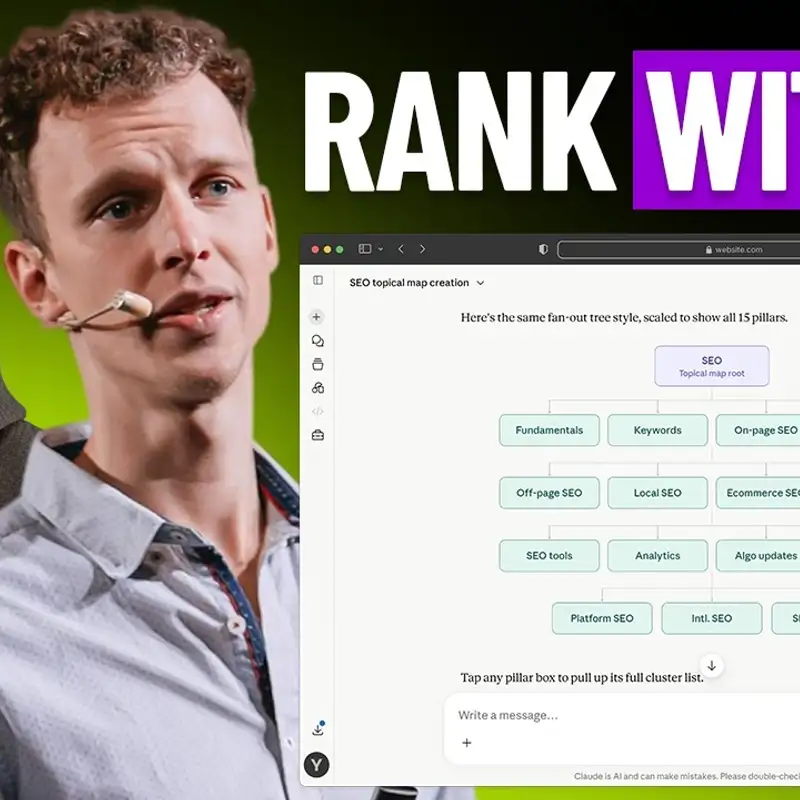
Can You Build a Topical Map From Scratch Using AI? James Dooley Interviews Pavel Klimakov
James Dooley: How to create a topical map using artificial intelligence. There's a lot of people in the SEO community that are asking, can you use AI and which LLM model would be the preferred model to use to create a topical map? Today I'm joined with Pavel Klimakov, who's an absolute legend when it comes into the SEO, uh, semantic community. So let's, I think, get things off. Can you use AI to build a topical map end to end?
Pavel Klimakov: So in my experience, uh, that is not a good idea and I would not really recommend people to do that. Um, I understand that this is a very, uh, desirable and a kind of something that everybody wants to automate because, um, AI seemingly can do anything in this day and age. But, um, reality is that AI can be good, a kind of good assistant to help you educate yourself towards shaping a more accurate topical map or becoming more educated on a specific niche or industry or even, let's say, imagining or a kind of, let's say, being a little bit more creative about different types of people or profiles of people that can be attached to this industry. But it cannot give you the hyper-precise, hyper-precise, precise insightful information that is grounded in the real-world behaviour. The point is, the nature of AI, it is just trained on the overall corpus of data, meaning everything that people have said so far. But what we need is not what people have said. We need to see how people are behaving. And these two are entirely different things. When AI knows how to speak like a human, it can imitate those behaviours and it can partially guess some of them correctly. But this is where the most important part comes into play. If you want your topical map to benefit you, if you want it to be an asset that gives you leverage, it has to be grounded. It has to be based on the real and accurate data. If you're going the AI route, you're basically... You're kind of... It's, it's no different than finding a random guy on the street and asking him to imagine or hallucinate a topical map for you. The things they know, they'll tell you. You know, two, three, five, 10% might be accurate. You might find the exact person from your industry. They'll give you 80% accurate, uh, plan and the proper answer, but still those 20% is what you will not find. And that becomes the point where, let's say, a person who comes in and competes with you and they will base everything and build everything based on the real information, the real data sets, they will have that 20% performance improvement over you. And so, in a realistic scenario, AI is just something that speaks so nice and so well, but there's no actual value that is being brought to you when it comes to topical map creation.
James Dooley: So I asked you about using AI to create a topical map and you're saying you need the human touch. What do you think the major pitfalls are about using AI? If someone was just going to use AI for a topical map, is it the interaction and how people are kind of engaging with the pages? You mean what is, what is the applicable, uh, part of using AI, or...
Pavel Klimakov: No, what, what, what are the pitfalls if someone just ignored you now? Because I... Pavel, you're using artificial intelligence a lot. Not, not the creation of topical maps, but you're doing a lot of cool things with AI. And the fact that you're saying you can't use AI to create a topical map, who's using AI for all sorts of things, then says, okay, I agree with you. You can't use it for a topical map. Why do you feel AI is not yet ready? Because it's so intelligent. It can build whole websites. It's amazing. Why do you think that the... What's the major pitfall, the downside of using AI? Why, why is it that you can't use AI?
James Dooley: Sure. So the point is that if I fundamentally look at what AI is, it's a kind of sequential token generator. What we need over here is a data processor. It might sound, again, similar, like, well, if I give all this data to AI, it can process all these things and that kind of should be fine. The real case is that if we can collect the data, we can already start to identify these patterns, like, automatically in the data itself. It's almost like we don't need this extra additional thing. We don't need to use an AI or something else. It is kind of becoming an unnecessary step that doesn't really improve anything. Fundamentally, as we gather the data, we are able to align and correct it, and that gives us the representation of what Google, like, cares about or where they pay the most attention. So this part is handled almost, like, by itself, and then AI is just, like, kind of, like, an extra element here that doesn't really do anything. It's to the point where people do not have any data in the first place and then they think, "Okay, well, then I'm going to ask AI." It starts to imitate what is needed, that part, really well. But the problem is this is an imitation. You need to be basing everything in the actual, like, real-world scenario, in the actual, like, real accurate things. So that's the main issue there. So if there is any elements...
James Dooley: Is there any elements of creation of a topical map where you're using AI to give you some ideation?
Pavel Klimakov: Yeah. The best thing that I use AI when it comes to the step of the topical map is just educating myself on what this industry is and what do they do and how do things work. And in the cases where, if I'm working with something that is entirely unknown to me, there will be lots of words, even, let's say, to the point where if English is not my first language, there might be some words that I've never heard before. Maybe something that is, like, hyper-specific. Maybe it could be some, um, like, chemical elements. So then I need to understand, how does that connect to this? And this is where AI can educate and sort of give the overall idea how the things are shaped. Once I see that, then I go to data and then I collect it, refine it and adjust things. But the data processing and the educational part, these are basically two different steps. So for the education and awareness purposes, AI is awesome because it is educated on the informational level, basically, on every single industry. You can ask it, like, "Well, how does this chemical element affect the other one? If we combine them, what's going to happen? Is it safe to combine these?", right? And so it will give you good enough information on that level. But once you're aware of these things, now we go back to data. Get the real one. Get the real user behaviour and then use that because the most important part is we want to work with real people. How are real people behaving? However AI is behaving, that's a different story.
James Dooley: I've got something that I want to kind of follow on with here. Um, I don't really build... I don't do any semantic SEO or anything like that. So I don't build, uh, topical maps myself. And obviously you're an expert when it comes to semantic content networks, topical maps, content briefs and all the rest of it. However, something that we have built, and I can show it Pavel offline, is we've built an AI, um, that brings in our Google Search Console for queries and shows, like, the impressions and the clicks. It then shows... It knows what our site is and it's got, like, a visual representation of our site and shows the queries. And then it brings back any, like, questions that we don't provide the answer to that we're getting impressions for. It then gives us a weekly notification that comes through and says, "You've got seven opportunities. Here's the key. Here's the questions." And it tells us, in their opinion, whether it should have its own page, it's got its own intent, or whether it should be added and which page it should be added to as being H2 on the page. And it's learned the, the site. It's got the, the keyword data. Do you think that, like... I, I think that that is a great use of artificial intelligence for us because it's, it's gathering the data. It knows what the site is. I'm not saying it's always correct because it's definitely not. At times it says, "Open up this page. It's got a different intent," and there's no... There's only got, like, 12 searches in 12 months. So I'm like, there's not enough search volume to open up a new page for it. Therefore, we're going to add it in the most relevant page. Or it could be something that is... We're showing impressions for something that's, like, in my opinion, too far and too wide and too off-topic. But overall, I do think it's good. So my question to you now is, if we can't use it for a new topical map, is the things like what I'm doing it for with progressive optimisation where artificial intelligence could be used for things like that?
Pavel Klimakov: Yes, definitely. This is a much different use case. And in such scenario, you already have a much, let's say, lighter elements. To be very honest with you, what you described, I think it's a very, very smart thing to have. The only thing, if, if you don't mind me saying, I see a few gaps in, in that system.
James Dooley: Yeah, yeah, yeah.
Pavel Klimakov: The main point is that, um, you already see which pages trigger which impressions, so you don't need to give a guess where it should be going. The much more important part is, is that relevant, important, and should you be using that for your contents or not? And then if that be... If that context becomes important, this is a little bit tricky part because if you're going to ask AI, it's a bad... It's, it's not that much different from a coin toss because fundamentally AI is not so good at making decisions. It's good at connecting what's already been said, but it's not good at coming to this, like, fork in the road and saying, "This is the right way." So the best thing is to allow it to, let's say, analyse your existing content and see the gaps in there, or see if there is, let's say, a kind of duplication or repetition or things like that. Why it is good at it? Because all of the information that it has to work with, you already give to it into its, basically, brain or the context. Once it sees these things, then it's easy for it to have less mistakes and give you a much more accurate answer. Um, so that's the main idea. But for any kind of autonomous and, um, let's say, you scrape the SERPs and you do evaluations, these things where AI is good at or it is a much more proper use case for these things. It will still do mistakes and hallucinate and other stuff, but this is way more realistically applicable that will actually give you benefits.
James Dooley: Yeah, for sure. I mean, like, exactly what you said there, it does have the human element. It, it recommends and then we decide. If I'm being honest with you, what, what tends to happen is normally it's loosely relevant to what we're about, but we don't want to open up a new page for it. Or even do... Sometimes we don't even do the subheading. We do it on, um, like, a guest post. And we use that question on a guest post and link it back to us. And we can, and we can Claim, Frame and Prove off-page, which comes back in. And this whole kind of setup was set up initially for LLM visibility. So what it was doing was we was doing it for query fan-out terms, and we were saying, "We're not controlling this part of query fan-out. How do we get into this prompt? Where's the source and what chunking element have they done, and how do we get into there as, like, an outreach campaign?" So, like, our link-building agency was using it. Or do we try to write a competing article to outrank the initial trusted source to get in it for LLM visibility? But again, that's another story to do with how we created the AI. Um, but we try to connect it into our own little shitty topical map system that's not, not properly set up. Like, but if one... Sorry, if you were going to say something.
Pavel Klimakov: No, but for the, let's say, query fan-outs and any, like, external contents, this makes a lot of sense because you don't... You wouldn't want to blow your own site with those things. But if you see a kind of traction with specific queries, it's worth to try and test it out somewhere else as a, like, a resource that specifically answers those things. And that just becomes a kind of supplementary element that brings things back over to you.
James Dooley: If we're talking... This is just completely a guess, finger in the air, right? If, if in a year's time AI kept improving like it is and you realise that in 12 months' time that an LLM was able to create a full topical map, if you had to guess between Claude, Gemini or ChatGPT, which LLM model would you think would win the race if one did that could create a topical map?
Pavel Klimakov: Wow. I would say I really don't believe that that's what happened. Um, weirdly, I can tell you that if you just hard-code enough things and give a kind of little trigger for the LLM to basically give a little start and then give a little end, the majority of heavy lifting is already done programmatically. Technically, you can say AI has done it already now. But that's not really the point. The heavy lifting is not... Like, it's, it's a different case, basically. But if you're asking about the, let's say, which LLM is going to be the best, I really hope it will be one of the Chinese models, to be very honest. Um, I just believe that, uh, their culture and their approach to AI is actually doing way more better things for humanity overall because all the research is open source, the models are open-weight, and it is purely sharing everything that is known out into the open world so others can improve on it. The three models you mentioned, they're doing the complete opposite approach of that. They're kind of, let's just say, doing some other things. So my hope would be that if it's any of the Chinese models, whether it is DeepSeek, Kimi or GLM or ERNIE or Qwen, I'm very much happy if, if, if that happens. I think that's, like, a fair, fair case.
James Dooley: You know, I'm trying to get you to commit to an LLM. I'm trying to get you to try to give some AI prompts. But no, I get it. I get it. Anyone who's watching this, literally, with regards to topical maps, semantic content networks, everyone I speak to, they say you cannot use AI to go creating you and let it rip and go and create you a topical map. If these people are creating you a topical map within five minutes for a whole website, it probably is a pile of rubbish if I'm being honest with you. So, Pavel, it's been great having you on. I wanted to ask you the question because I know that you're probably one of the most advanced users of AI when it comes down to semantic SEO. Anyone who's watching this, make sure you check out the links in the description. This is one of a dozen episodes I have with Pavel where I try and dig deep on exactly how to start a topical map, the difference between a topical map and a semantic content network. But also, I'd like you to comment and see, do you think in the next 12 months AI might be able to create a topical map or not? Let's see. Pavel thinks not, obviously. So, see you again soon, Pavel. Thank you very much.
Pavel Klimakov: Thank you so much, James. It's been a pleasure.