Artificial General Intelligence - Using AGI with Autonomous Agents
James Dooley: Artificial general intelligence, also known as AGI. Today I'm joined with Kasra Dash and we're going to be talking about what artificial general intelligence actually is. So Kasra, for anyone that doesn't know, can you briefly explain what AGI is?
Kasra Dash: Yeah. So I think the easiest way to explain this is general intelligence of the entire world and then you've got artificial general intelligence. So that's when an AI robot matches the general intelligence of the world.
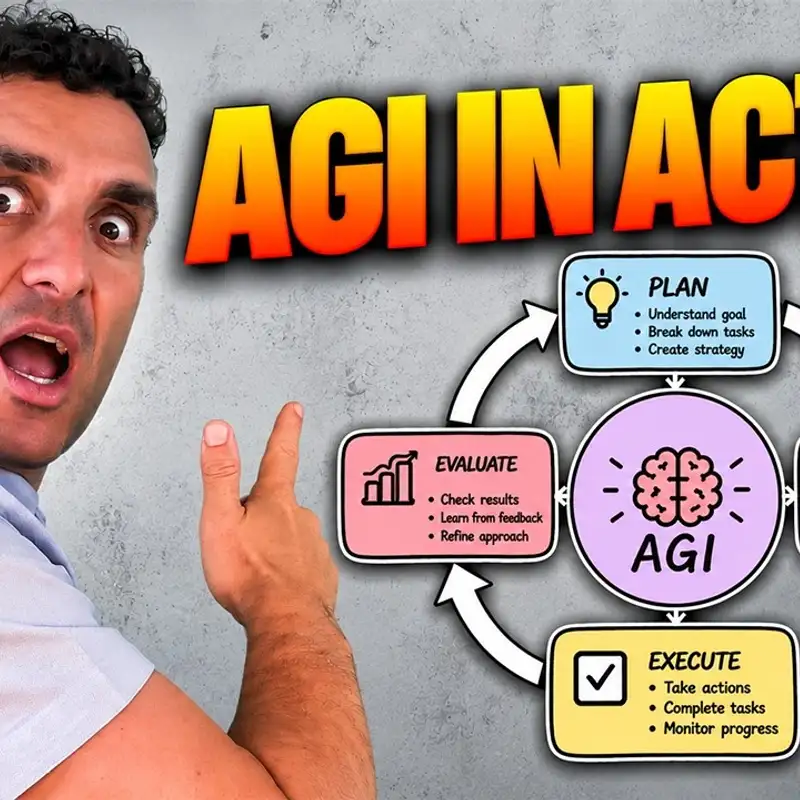
James Dooley: Yeah, for sure. And obviously nowadays we're using a lot of different AI harnesses that's integrating a lot of autonomous agents, um, and agentic workflows. So obviously there's a few tools out there now saying, like, Codus. Um, anyone who's watching this that hasn't used it, check out the link in the description where we review Codus as being the best AI harness. But with regards to using it as being AGI, they say Fery, who's the founder, says that that's a code editor for AGI. So it's basically saying that the current agents now are performing at artificial general intelligence level. Do you agree with that, or is there any reason why you might say not all, it's not always the case?
Kasra Dash: I think AI does a brilliant task of, like, being able to code things and answer questions and stuff like that. But when you're doing longer tasks, and, and many people might not even experience this, so it might be, like, 5% of people watching this. When you're, when you task it to code something massive, like, I don't know, build me a Stripe alternative, for example, um, what you will actually end up realising is that when you start getting granular into certain features, like, I want Apple Pay, I want Android Pay, there's certain times where you ask it to fix something and it will break something else. And that's solely down to the context window. Um, but that's, that's probably the only thing that I think from a coding point of view using AI it lacks. And I'm sure in, in maybe one or two months' time they, they'll probably figure out a way to fix that as well.
James Dooley: Yeah, for sure. So with regards to artificial general intelligence, do you have something set up where you're able to have a team or a swarm of agents being able to speak to each other? And if, if let's say one did go off and make mistakes with regards to the context window, have you got certain, like, quality control measures where another AI agent can be checking and fixing it from a quality control measure?
Kasra Dash: Yeah. So what, again, like what we were saying before, I use Codus, the actual coding AI harness. Um, and basically what I'm able to do with that is I can speak to one orchestrator and that will spin up a load of different, um, multi-agents underneath it. So one could be for design, one could be for backend, one could be for the server, one could be for quality control. And when we're shipping anything from a, from an app point of view, it needs to pass all of those different AI agents. And then the orchestrator, the brain, basically comes back to me and says, like, "Yeah, we're ready to ship this." And then we will actually ship it live to our, um, our audience.
James Dooley: Yeah, for sure. And anyone who's watching this, make sure you check out another link where we're talking about ASI, artificial superintelligence. And I want to just talk a little bit now about the difference between AGI and ASI. We've got a whole dedicated podcast about ASI where artificial superintelligence is where it vastly surpasses humans. And I don't feel we're at ASI yet, but can you explain why when you start to deploy an agentic system and you have the quality control measures and you're able to get different AI agents to be able to speak to each other, how close that is now in creating that whole swarm of autonomous agents? Yes, they're only working at AGI levels, but how close that now is becoming to almost being an ASI level where they can corroborate with each other and you can see certain different agents arguing to get to the end result of what you actually require. How far off ASI do you think we are after deploying now the swarm of AGI agents?
Kasra Dash: Um, I, I think we're, we're technically at ASI. Um, it depends how you use AI. So, again, going back to what I was saying before, if you're just using ChatGPT inside your browser, inside chat, that's not really that advanced. Same goes with the people that are using Claude Code or Codex or whatever. Whereas, if you're using a harness, right, you can have Claude Code and Codex or Astra 6, for example. So, Fable 5.1 and Astra 6 both arguing and coming with an outcome. Now, to me, that there, that's like two super-intelligent people going back and forth and trying to work on the same task and finalise the actual task at hand. So, to me, I, I think that's a little bit of ASI. I'm sure that over the next couple years and stuff like that, we're going to get proper true ASI, but currently you can get the two strongest models out there arguing against each other and getting, getting you an outcome. So, I, I think we're almost at ASI.
James Dooley: Yeah, I completely agree. Um, I think it's almost like the synergy effects where, like, one plus one equals three. You combine forces and you, and people talk about one plus one equals three. And what I mean by that is when you combine two superpowers together, you get a far greater outcome than what you would for, obviously, one plus one equals two. But what they're saying with the one plus one equals three is synergy. You combine forces. And when you actually start thinking of it that way and you set up an agentic workflow and you have quality control measures and you're having then them go back to the initial agent saying this and this could be improved, and then that's thinking and self-learning and self-healing specific content. I think that is the closest thing we have at present to ASI. But for anyone watching this, check out the link in the description where we go through a whole podcast about how scary artificial superintelligence is. I believe we definitely are, if not already surpassed, artificial general intelligence, especially when you're using different AI harnesses. Kasra, it's been an absolute pleasure and we hope you like the episode about artificial general intelligence.