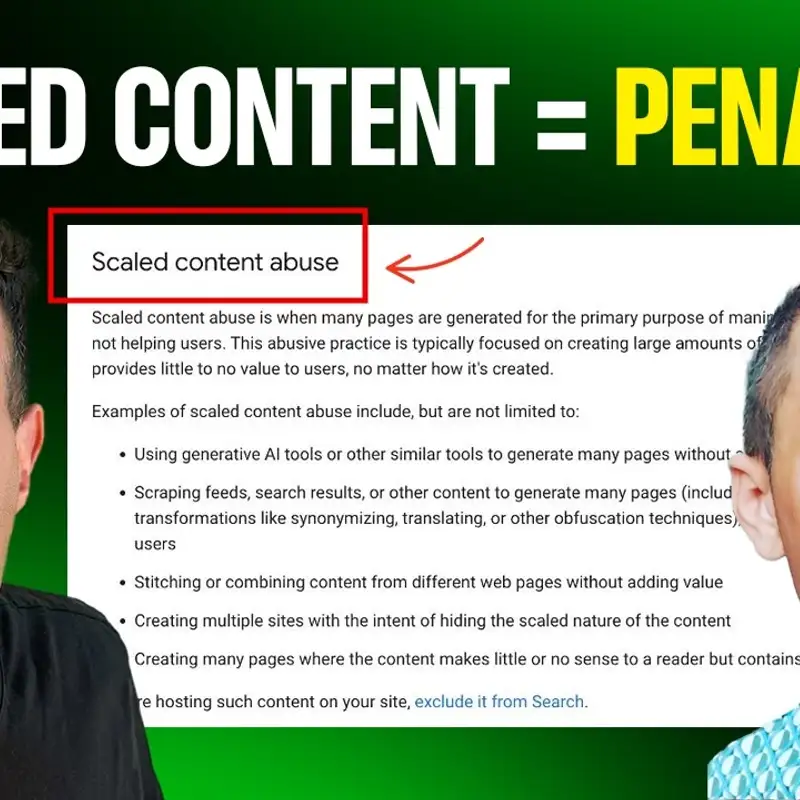
Scaled Content Abuse Google Manual Action Penalty (James Dooley Interviews Daniel Foley Carter)
James Dooley: Scaled content abuse, manual action penalties. There's plenty of them and I can see Daniel Foley Carter is like this. He's ready. He's ready to talk about it. He's seen a lot of them. I've seen all your LinkedIn posts. So, let's go jump straight into it. A scaled content abuse penalty. Why are there so many being handed out at present?
Daniel Foley Carter: So my theory on this is because, uh, they've been training Gemini for years, uh, on, on the open web, right? So when they started training their AI models, most of all the content that they trained it on wasn't synthetic. You know, it was, it was content that you and I and everyone's created over the last 5, 10, 15, 20 years. But the problem is, is that what's happening now, and what I, what I feel is happening, is that AI fundamentally is, is, is polluting, polluting a lot of the web. And, and they're fundamentally training their models on content that was generated by AI. So it's like, it's like a crocodile... A crocodile eating its own tail, right? So eventually, if the models are, are learning and being trained on the very content that they produce, over time they're going to have more and more, uh, inaccuracies in the data. So I think, I think what Google is doing now is, you know, to, to help try and reduce that, they are... They're, they're incentivising people to not use AI solely to create content without at least putting some effort in. I think the other, the other part of it as well is generally there's a couple of things that... This is what I think. It's not what I know, but it's what I think. So, there's a couple of things here. Number one, um, because it's so easy to create content at scale now is it's tantamount to the problem that Google has had for so many years with, uh, dodgy backlinks. So, like, we spent years with Google constantly playing cat and mouse with link building, right? Uh, you know, when they, they release updates, you know, we remember Panda and Penguin and the updates like that. But I think what's happening now is, like, scaled content abuse is so much easier to do than spammy link building. Um, and I think what Google is trying to avoid is SERPs becoming flooded with manipulated content or with content that has factual inaccuracies or where the output of that content is not for the end user and therefore the search experience goes down. Um, so I think what Google is saying is that it's not a problem to use AI content. It's you can't just deploy this stuff at scale without at least having it fact-checked, without actually thinking about, hey, is this content good for the end user? Does it meet their needs? How is it formatted, presented? Does it have images in it? Is it actually engaging? Um, because we all know Google spent a lot of years building its market share because their search was simple and the experience was better. You probably remember back in the days when there were 50, 100, 500 search engines. You had AltaVista, Freeserve, Lycos, HotBot, Inktomi, Angelfire, GeoCities. You had all these search engines, right? But Google grew its market share because the result quality was better and because it was a simple UI. But I think, I think now Google's destroying its own search experience with AI Overviews and all the rest of it. But I think now what they're actively trying to do is stop it getting even worse and stop people seriously abusing SERPs because you imagine you can abuse links and you can abuse content, right? So Google's really now putting down the hammer to try and stop this stuff. Um, and it's funny to see because Google doesn't catch a lot of it. Um, and the stuff that it does, it does catch, you know, is, like, shocking. Um, so yeah. So those are my thoughts why, why they're trying to stamp it out. Let, let me read two of them out and then I... It'd be interesting to hear what you think the main difference is because there's, there's two different detected issues.
James Dooley: So one of them comes back, the manual action. I'm just going to read it out. It says, "Thin content with little or no added value. This site appears to contain significant percentage of low-quality or shallow pages and do not provide users with much added value, such as thin affiliate pages, cookie-cutter sites, doorway pages or copied content." And that penalty, which is the thin content with little to no added value, affects all pages. So that's, that's penalty number one, right? But then penalty number two, which still kind of falls in line with it, looks like a very similar type scenario related to mass content abuse or whatever. Major spam problems. And then this one then says... Let me get it up. Major spam problems. "Pages on this site appear to use aggressive spam techniques such as scaled content abuse, cloaking, scraping content from other websites, um, violations of Google's spam policies," and again affects all pages. What, what would you say the difference is there from the thin content to the pure spam?
Daniel Foley Carter: Um, so really with the thin content side of things, um, it typically... It's typically done when people are producing large volumes of pages that are long-tail orientated. Um, so for example, where you might have a, a services page with FAQs where people have gone out to create micro pages for spec... For, for specific keywords, but going after thousands of iterations of long-tail keywords. Um, so what you typically tend to find with those is that someone can create an automated or a programmatic content strategy which just targets keyword, keyword, keyword, keyword, keyword. And those pages don't typically have much depth to them. Um, you tend to see more of those with old-school strategies that still exist. They're not as effective now, but you remember the old location page strategy where you'd have a company that, you know, did, like, I don't know, locksmiths or cleaning or something, and they would have, like, a micro page for every postcode or area in London or Manchester. Um, so those, those typically were more the pages that would fall into, uh, thin, thin content, where there's not generally much content or there's not much deviation between the content. So you would have, like, a 1,000-word page or an 800-word page and where you'd have, like, 300 words about the area and then you would have a few hundred words about the service. And the content was so similar between all the locations, it just tried to differentiate itself. So there's that. And then with the, the... With the major spam, um, that's really... That, like, it's such a broad definition. So, I've seen both of the, the penalties that you've mentioned, but when you look at the sites, they've actually shared a lot in common. I think what they, what they do is they look at the, the volume of content. I think that's where it becomes aggressive spam. Um, so examples of that are people that are putting out, you know, a thousand pages plus a day. And what they, what they are typically doing and what I've seen as these strategies is they buy these, uh, uh, these autopilot tools, right? So you pay, like... They're like, "Oh, pay $59 a month or $99 a month and you... We generate your content on autopilot." But all they're doing, all they typically tend to do, is they'll, they'll use, say, Ahrefs MCP to, to get the first page of results, and then they're just using AI to regenerate that content. Um, or they're just taking specific competitors and regenerating it. And because what they typically tend to do is they do it at scale and they're generally doing it on domains that aren't established or aren't trusted. So, where you're more likely to get an aggressive spam, uh, penalty is more if the domain doesn't have history or isn't a, a, a brand with any pre-existing credibility. So, if you had, like, a, a site that was 10 years old and they're put... And they start pushing out content at scale, they're far less likely to get an aggressive penalty versus someone that's just bought a domain, chucked a site on there, and then started the automation. Those are the ones that typically get the, the more aggressive ones.
James Dooley: So, I want to give you one or two examples, right, and see what your thoughts on how you would do this, how you'd build it and stuff like that. So two different examples is one you mentioned there, um, like a location site. So let's, let's run with, let's say London and let's say they're, they're a plumber in London, right? And then the second example will be an e-commerce website. So the e-commerce website, they come to you and they go, "Daniel Foley Carter, I've got 5,000 products that we want to sell on my e-commerce website. I've got budget, but I'm worried about scaled content abuse. If I just go and add all 5,000 pages all at once, I feel I'm going to get hit with scaled content abuse. What do you suggest? Do I do category by category or whatever?" And on the other example, a plumbing company comes along to you and says, "We work within a 150-mile radius." And they was to go and get, like, all the major cities and towns in the suburbs of London and could be Essex and Kent and all the others. And for, like, plumbing Kent, plumbing Bristol, plumbing and all these other areas, they all got, let's say, more than 100 monthly searches. So there's enough demand. But again, there was 5,000 pages for plumbing in these different areas. Now, yeah, your plumbing person that comes to you that's got big budget says, "I've got the budget and I want to make certain I can rank because I've got engineers in all these places." What, what do you do to prevent from scaled content abuse on the e-commerce and on the local?
Daniel Foley Carter: So, I mean, with the e-commerce one, um, it's, it's less likely to, to get a scaled content abuse penalty because you... To get these penalties, someone manually is reviewing these sites, right? So, I have an idea of how it works. So, what typically tends to happen is that, um, Google has, uh, automated detection systems that will flag sites that need a manual check. Okay, so it's almost like a domain comes out of nowhere, it ranks for a high-value casino term really quickly. It's an... It's an outlier, therefore triggers the... Or, uh, triggers a manual review. Uh, and then that person goes in and takes a look at that site. What, what is it doing? What's their links like? You know, they take a look. If you are an e-com business and it's a genuine business and you're deploying products at scale because you're a new business, you're not likely to get a manual action for that. Like, yes, you're deploying a huge amount of content in one go, but when you look at it, if it's product orientated, it's a bit different versus someone that is hitting out articles at scale. Um, generally there's, there's another caveat to this, right? Um, what typically tends to happen is that if a, a new e-com brand launches a site and they, they got their 5,000 products, doesn't actually mean that those 5,000 products are going to get indexed. And in fact, if the domain is young, new, doesn't have any history, they can deploy 5,000 products. They're probably going to have a really, really poor indexing response until they start building links and brand trust because it's an e-com business. So we know that it's going to be more reliant on the brand having trust. So links, genuine limited company, incorporated. So it's, it's far less likely that even deploying products at scale is going to lead to any form of manual action. Um, I'd say the only exception to that would be if you were to deploy at scale, you were to get, like, an initial burst of traffic, and then you would abuse something like structured data in a way to try and manipulate getting listings, like, like when people used to abuse aggregate rating. So that's that. For the plumber. So the... It's hard because the, the, the micro-location pages can and do still work. But again, you are moving into more dangerous territory now where at some point, if you are not careful, depending on how dirty your strategy is, like if you've got a crappy link profile and you're pushing out micro-location pages, they'll either get de-indexed at scale or at some point you'll get a manual action. Um, so the way to do it now is you don't necessarily need to tie yourself into all the, the micro locations. You can have broader locations, but generally, um, what you would do is you would have, like, a service page for a location, but you need to validate that. So you should... [Snorts] ...have a GMB that is tied to that location because one of the things that we know, especially with how, uh, how aggressive Google's got with GMB validation and GMB address changes. It's like now you, you can't just go and get virtual addresses easily now and things like that. You need a physical presence in those locations. So we, we know that Google understands that a plumber might live in London, but he might cover 50 miles or 100 miles around, right? So, he's not necessarily going to get penalised because he's got location pages scattered around, but he is more likely to suffer if he's creating loads of these micro-location pages and he doesn't have the... He doesn't have the brand equity or the, or the link profile behind it to back up enough weight and trust. What typically tends to happen, and I see this over and over again, handful of location pages will do okay. Some will be really weak and won't perform. And then a load of them just won't get indexed. Um, and because of this, what typically tends to happen is if loads of stuff isn't getting indexed, then it's far less likely to incur a manual review anyway because it's not indexed. [Snorts] So now the way I would do it is I would say, okay, well, you know, I'd look at the main towns. You know, so you could have, like, Kent, you could have towns around, and you could have a town page, but you then need to think about, you know, you should have an address for that locality, a phone number. You need something to cement that you're not just writing that you work here, that you actually have a presence or you trade there. That is the best way to overcome those problems. But unfortunately, there is no one-size-fits-all. Like, you could do loads and loads and loads of location pages, but we know that Google has really, like, put down the hammer on people doing that. And the only way really to overcome that is to have really good content for each page that's unique enough and where you've got sufficient links to back up... Back up warranting that page being indexed.
James Dooley: Yeah, for sure. Anyone who's listening to this, have you suffered from a scaled content abuse manual action penalty? Leave a comment in the comment section. What are you doing? Obviously, you're getting sent quite a lot through. Are you auditing it and then looking to try to delete the pages that's there and doing a reconsideration request on their behalf?
Daniel Foley Carter: Yeah, I mean, the thing is, is that I wish it was that simple. But quite often the... What I'm seeing now as well, a lot more of, I'm actually seeing hybrid manual actions where they're getting three, four, five manual actions together, not just one specific thing. Because what happens is, and what I have been seeing, is that there are businesses that have cheaped out on SEO, right? So they've ended up with tons of crappy links. Then they've obviously... We've, we've all seen it in Ahrefs where you get all the aggregate spam and all the stuff that just appears out of nowhere, the Telegram anchor texts and all this other stuff. But what tends to happen is that they would have been lined up for a manual action, but they've escaped it. And it's not until they've tipped the content threshold over that someone's then gone to manually review and gone, "Ah, well, not only are you abusing content, but you got a terrible link profile. It looks artificial." The, the interesting thing, right, is that we've gone through some phases over the years. And it's what's happened with Google is that for years and years and years and years and years, you could get a penalty and you could get a penalty easily. Like back in 2012, 2013, it was not hard to get a penalty. But then what happened was the, the negative SEO industry grew massively, right? And it... Like, like the equivalent of DMCA takedowns now, right? You've just got people that used to just go out and send thousands of spammy links to a domain to try and get it displaced or to get a penalty. So, Google facilitated negative SEO and genuine businesses were getting damaged by it. So, Google's had to change their policy in that rather than penalising someone for crappy links, what they do is they just devalue them. They just don't give the value in the first place. But we had a few years where, like, link penalties almost disappeared. I, I was auditing sites that had the, like, the most ridiculous link profiles ever and they were not getting any manual actions. But now, ever since... Ever since we've seen an explosion in AI content, it seems like Google's gone back to the table and now they, they will look at content and links together. Um, but fixing these problems, it's not just a case of deleting the content. So, especially if the domain, right, if you've bought a domain and you've put a site on it and you've started out as content abuse by deploying loads of these programmatic pages, getting the reconsideration request through is actually harder than just abandoning the domain and starting again, but just not doing it so aggressively. I've seen that, um, trusted sites tend to be easier to get through the reconsideration request. And quite often, more than not, you have to actually sacrifice content that was performing to get the reconsideration request through, which is a shame.
James Dooley: Yeah, that's exactly the same as what used to be with the unnatural links penalty. You'd need to go very aggressive on disavowing as many links as possible. Even, even some what you thought might have been okay. You just... If it didn't feel like you was getting rid of majority of the links in the disavow file, it just rejected. And then the minute you put majority in that...
Daniel Foley Carter: I've not... I've not actually done anything on the scaled content abuse ones, like the thin content ones. But what it used to be on the, on the unnatural link penalties, you'd almost disavow, like, 98% of the link profile and then bit by bit, if you thought some of them was good, you'd undisavow them in time.
James Dooley: Yeah, you might be able to do that with... Go very aggressive, removing all the content, save them all as draft, delete the ones that you think, all right, this was scaled content abuse. This was thin content. There was no added value. The ones that you genuinely think is good, bit by bit you start building back momentum. Build back, like, make sure it's got unique images, unique content, a bit of information gain, whatever, just so it looks good and not just AI slop. And then hopefully then they can... You can start building it up with this. Don't abuse the scaled content abuse. The, the other... The other interesting thing is, is that, so I spent years, like, analysing, uh, Google's data warehouse leak. So, yeah. [Snorts] Everything from NavBoost to site quality score, spam thresholds. And what also seems to happen is that once you're... Once you've had a manual action, uh, and you get the reconsideration request through, uh, you... The, the automations that Google may use in different combinations take time to reset. So I'll give you an example. When... If a site suffers a degraded quality score...
Daniel Foley Carter: So Google uses something called site quality score. So it's an overall score of the entire site aggregated, right? My theory is that when you get a manual action, that score immediately gets knocked back massively. But it doesn't just go back because the reconsideration request gets approved. What I think is that the domain then goes through a level of suppression. Um, and that suppression is then only defeated by time and then genuine efforts. I.e. then you have to go through actually deploying content of value, actually getting some good links, and then you go through a painful one, two, three-year process. Like, because I've got reconsideration requests through and it's not, you know... It doesn't... The traffic doesn't come back to what it was. Um, so people need to be really mindful. And, you know, I've seen... I've seen sites... I was working on one two weeks ago where they were doing, you know, nearly 2 million clicks a month and they went down to 20,000 clicks a month. So they, they just got absolutely decimated, you know. And, and they were... They were, you know, they're making loads of money from affiliate commission and then that money's gone like that. And you think they had loads of human editorial content and then they just started cutting corners with AI content at scale, and now look, they're probably losing an absolute fortune. So people do need to be careful. It's only... The only, the, the only industry really that benefits from this is people in, uh, doing churn-and-burn sites. You know, so get stuff in casino affiliates.
James Dooley: Yeah. It ranks for a couple of weeks, two or three months. You get your affiliate commission, site gets bust out the index, deploy another one and repeat it. And that, that... They're probably the only sectors that, you know, it's more viable, uh, for these things.
Daniel Foley Carter: Yeah, for sure.
James Dooley: Anyone who's listening to this, let us know what you think with regards to the scaled content abuse. Is it the content quality? Is it AI content? Is it the programmatic SEO part? Or is it just the volume of articles being deployed all at once? I'd love to know in the comments your thoughts on the reasoning behind all these manual action penalties of what's coming out. Daniel Foley Carter, it's been an absolute pleasure and I'll have you on again soon.
Daniel Foley Carter: Thank you very much for having me.